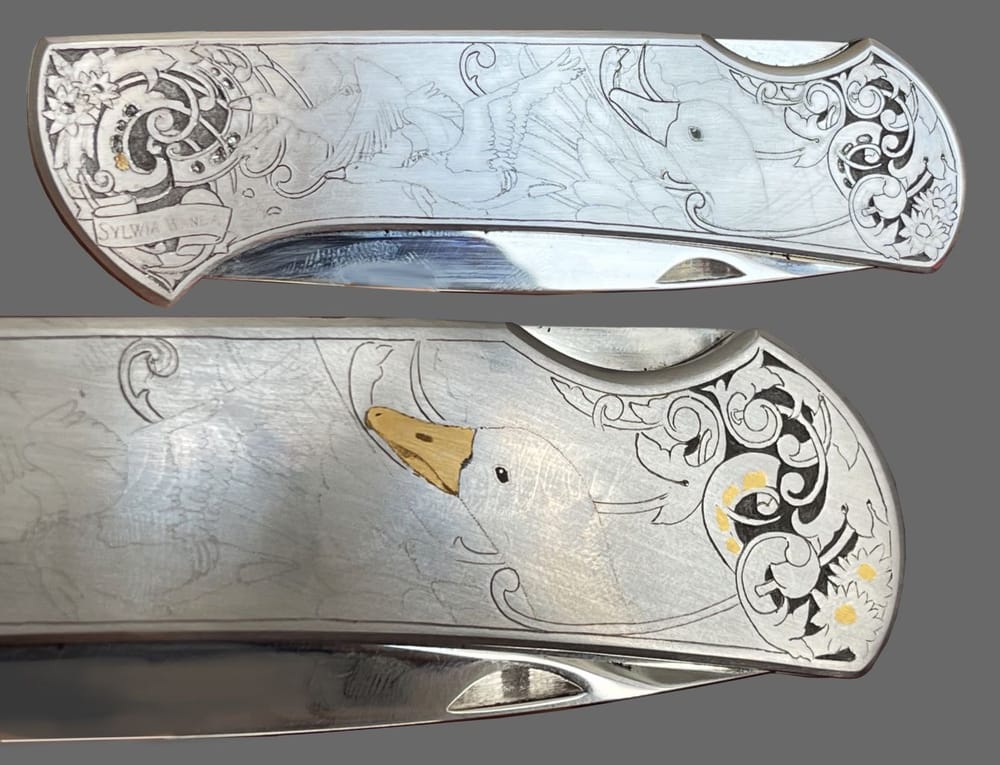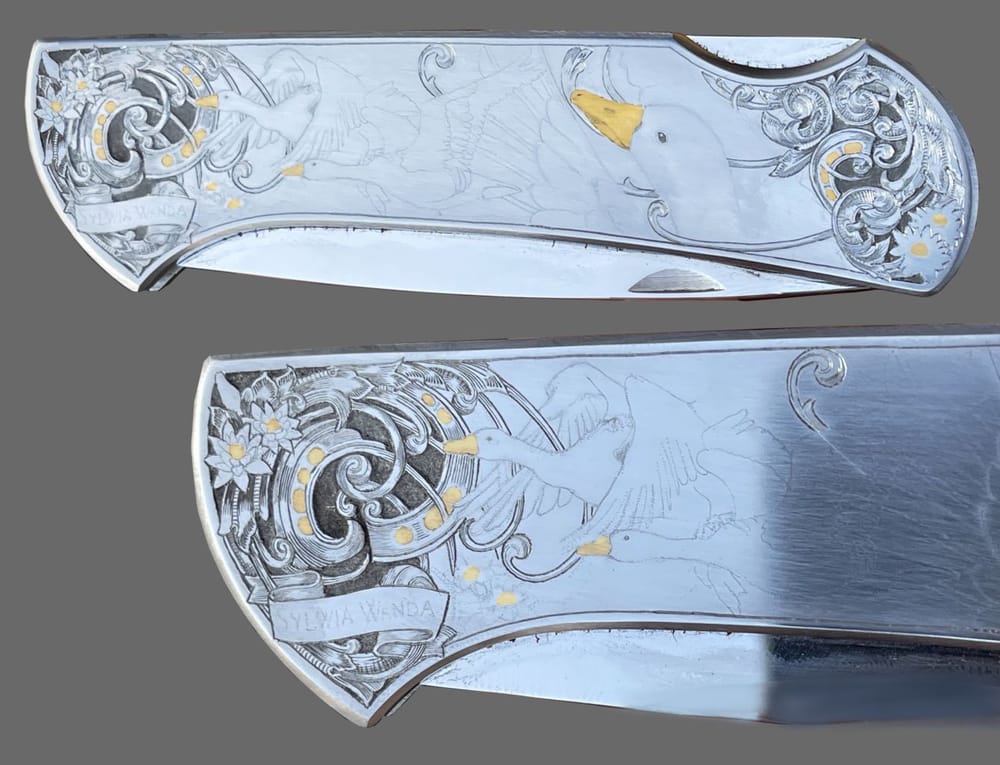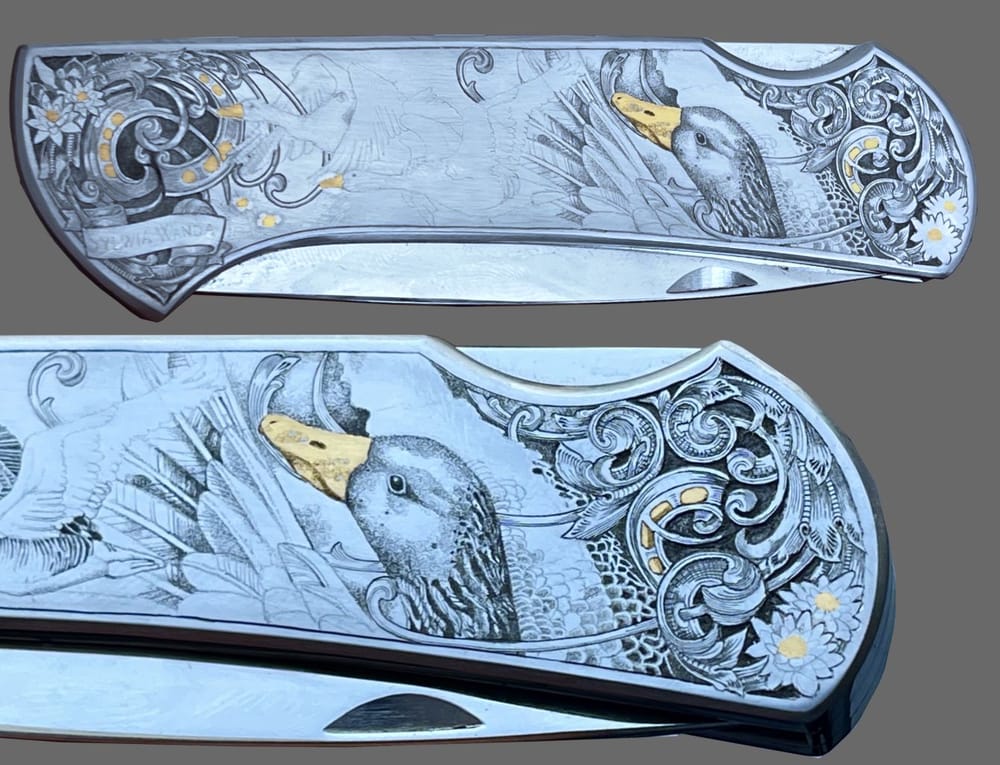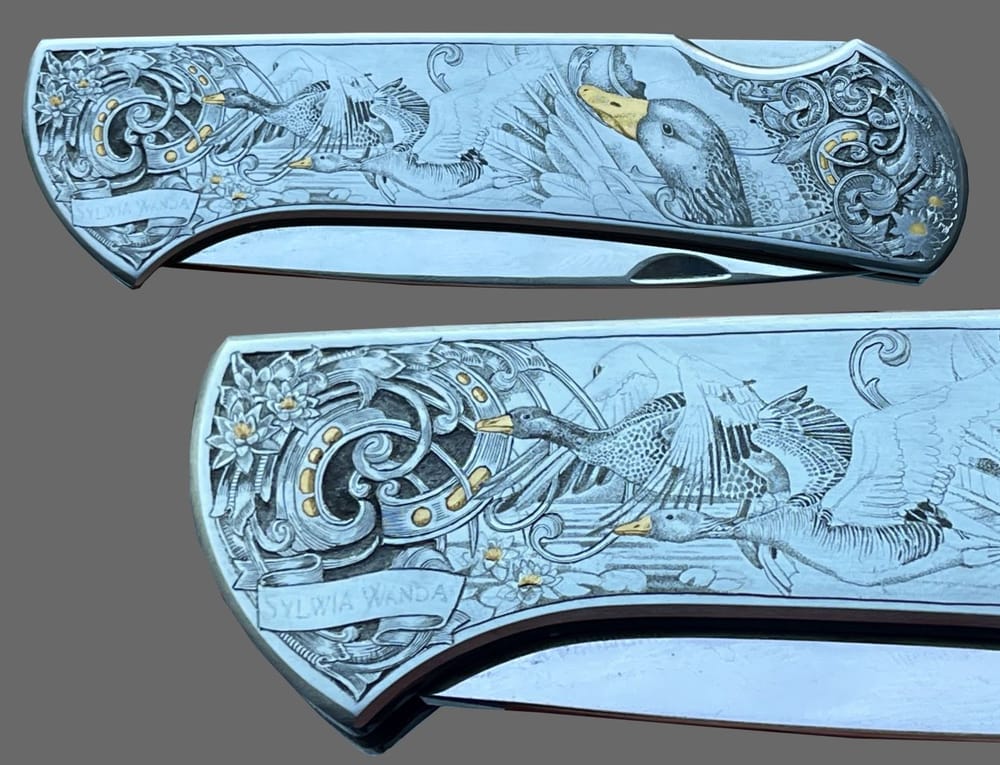
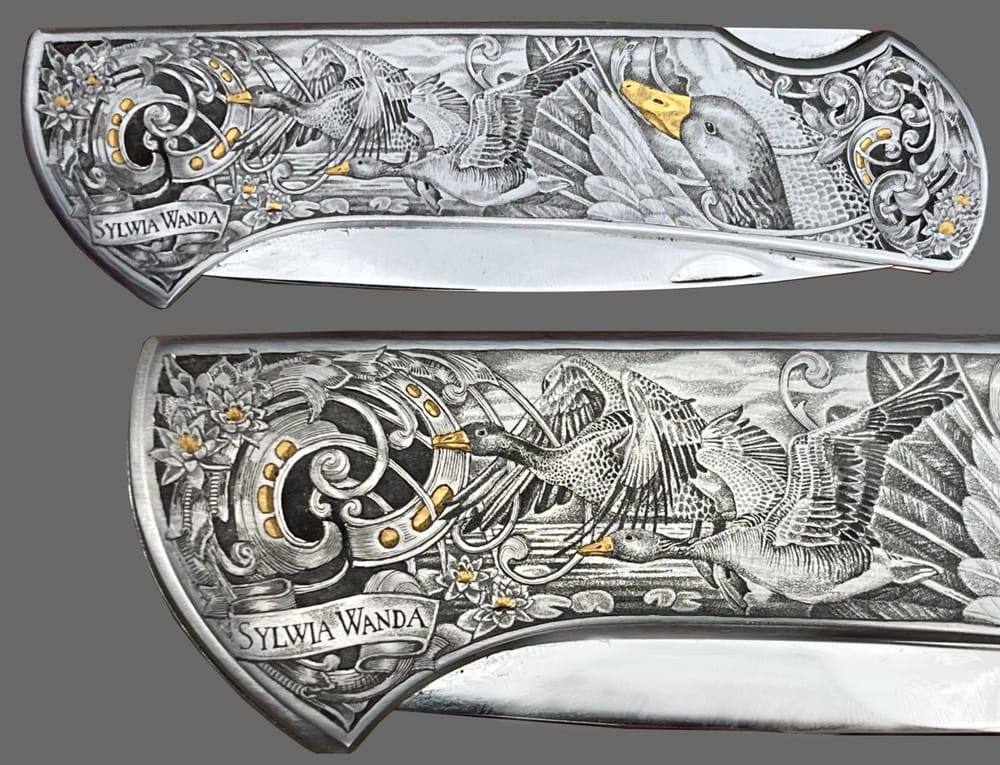
Most of my hunting clients ask me to engrave a Finnish-style hunting knife, usually with a horn handle and small steel fittings. The decoration on such knives is rarely spectacular, because the metal surfaces are simply too small. Now and then I work on a folding knife whose entire handle is made of steel. That is well worth the effort: it offers a large surface to work on, and the theme is limited only by the owner’s imagination 🙂
Stages
The scenes do not have to be strictly about hunting, although on this particular knife they are. There are two mirrored compositions with waterfowl, an absolute classic among water motifs: one side is dominated by a greylag gander and goose, the other by a matching pair of mallards. The large surface also allowed for a close-up of each bird’s head; together they show both the whole animal and its detail. The edges of the handle were left for acanthus scrollwork, which usually works well alongside hunting scenes thanks to its graceful spirals and finely curved leaves.
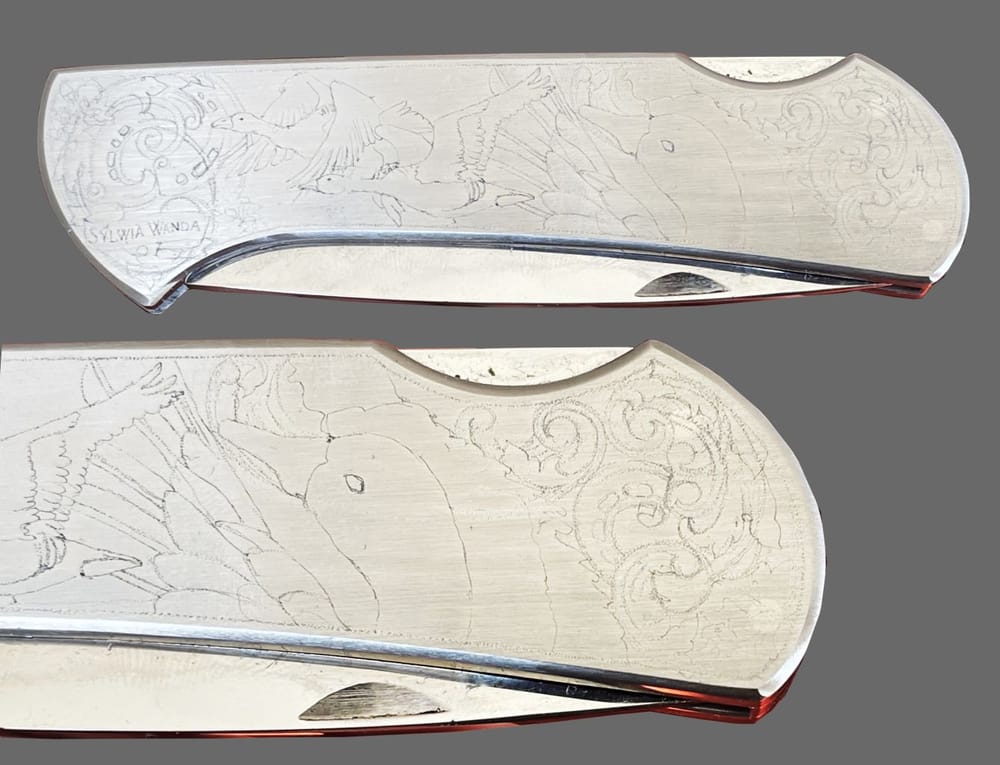
From the start the plan included inlaid gold accents, designed to add a little contrast without overloading the composition with gold. The best idea turned out to be highlighting the beaks, the water lily flowers and the small openings in the leaf ornament in gold. The result is natural and at the same time refined. This post shows only one side of the knife; the photos follow the stages in which the engraving of the geese was made.
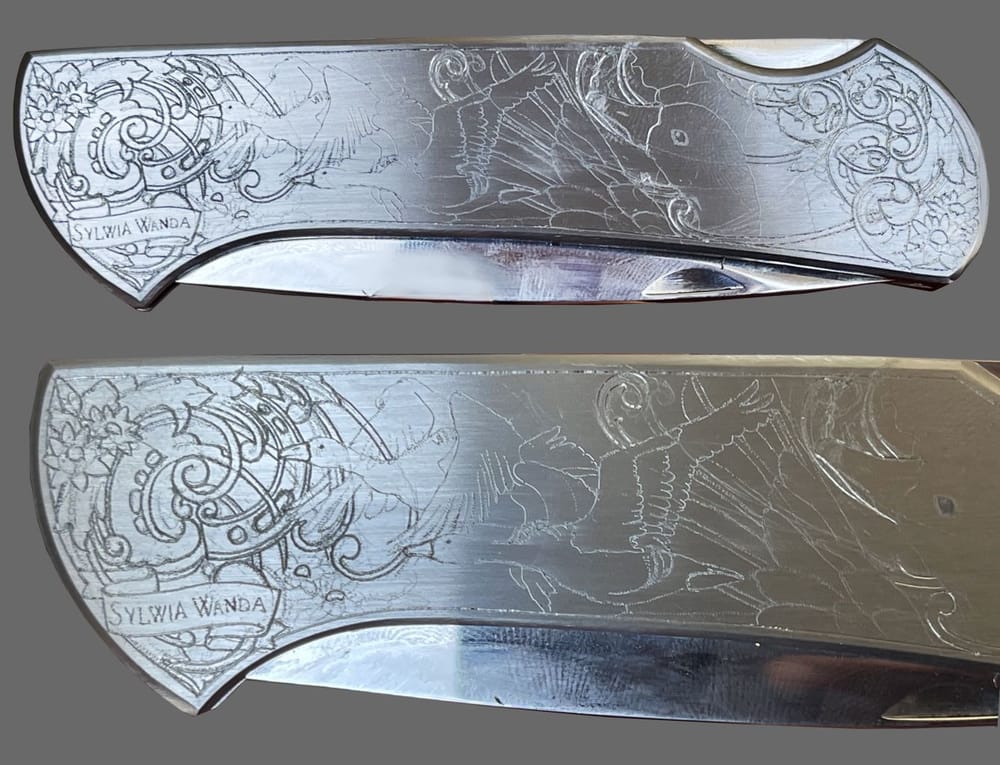
After preparing the design (my main concern was to show the birds in well-composed poses and to keep the two sides of the knife more or less mirrored), I could transfer one side, first in pencil and then with a scriber. In this piece the background is not removed; it is deepened only in the ornament, while the water scenes are engraved with dots alone (the bulino method). This means that I used the faceted graver (as always) to cut the acanthus, and on the animals only to cut the shapes of the beaks (and the water lily flowers). I then deepened these cuts with a contour graver and removed the inside with a flat graver and a pneumatic handpiece. Once the recesses were deep enough, I made undercuts to hold the gold inlays. I hammered in the 24-carat gold (after heating it) with a jeweller’s hammer and a copper punch; the gold itself was prepared as two wires, 0.3 and 0.7 mm. Once the whole side was inlaid, all that remained was to remove the excess gold with sandpaper wrapped around a small stick, so that it wore down gradually and evenly. It is essential to work through the grits, from coarse (240 to 320) through medium (500 to 800) to polishing (1000 to 2000). I applied the bulino to the fully polished handle, including the gold inlays, which made them realistic and in harmony with the rest of the composition.